The forest man shelters the mother and daughter and has a goat nurse the girl
The Most Precious of CargoesThe forest man shelters the Poor Woodcutter’s Wife and her daughter at the moment flight leaves them without a home or a safe path forward. His protection grows out of an earlier, practical exchange: firewood for milk. In the forest’s hidden clearing, he turns that fragile arrangement into sanctuary, and the goat becomes not merely a source of nourishment but the child’s wet nurse and companion. The episode makes survival a collective undertaking, sustained by labor, shelter, animal care, and trust under the threat of persecution.
The need for milk and an earlier exchange
The rescue has its roots in the child’s first days with the Poor Woodcutter’s Wife. The baby, whom she has taken from the snow, is hungry, and the woman realizes that her own body cannot provide the milk the child needs. The need is immediate and specific: without milk, the little one cannot survive and thrive. The woods offer no easy remedy, but the Poor Woodcutter’s Wife knows of a solitary inhabitant who lives in a secluded grove and keeps a goat.
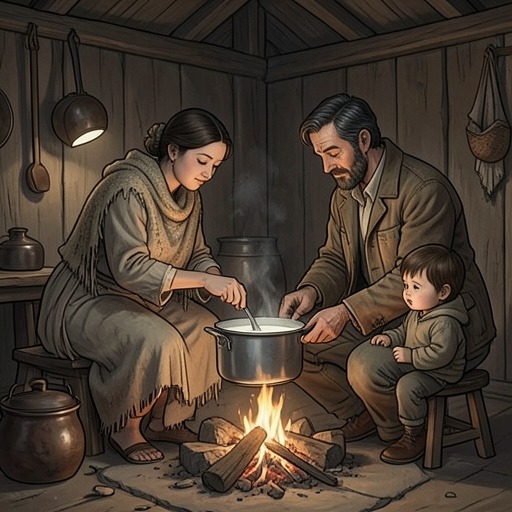
She approaches the grove with the child wrapped close against her, unsure whether the Man with the Goat and Shattered Face is present or whether his goat still gives milk. Instead of asking for a gift without conditions, she proposes a recurring exchange: she will bring firewood, and he will give her two mouthfuls of milk. His challenge to the bargain exposes its odd economy—the wood is not his—but the arrangement proceeds. Each morning, the Poor Woodcutter’s Wife carries a bundle of firewood and receives a warm cupful of milk. The repeated journey makes care a routine, not a single act of rescue, and ties the child’s nourishment to the mother’s daily labor.
The Man with the Goat and Shattered Face also gives practical instructions. He says that goat’s milk should be diluted with boiled water for the next three months, and supplemented with porridge, followed in spring by fruit and vegetables. The Poor Woodcutter’s Wife takes the child back lovingly and tries to kiss his hand; he recoils and tells her to get up. He also insists that she neither kneel before him nor tell others that he has a goat and gives away milk. His help therefore carries a clear boundary: it must not become public knowledge that could endanger the supply or the people who depend on it.
Flight to the hidden grove
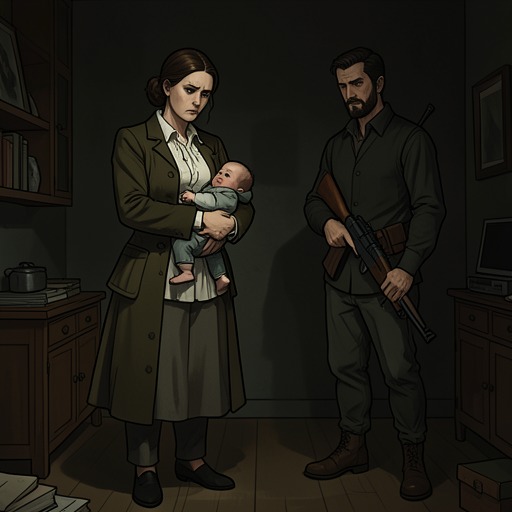
The arrangement becomes sanctuary after the Poor Woodcutter is killed and his wife must flee with the child. She carries the little one close and does not turn back. The Hunters of the Heartless are tracking her, and the Foxes run ahead through the forest, leading her toward a dense thicket considered impenetrable. Their path takes her to a place where ordinary routes of escape have run out and the hidden grove becomes the only possible refuge.
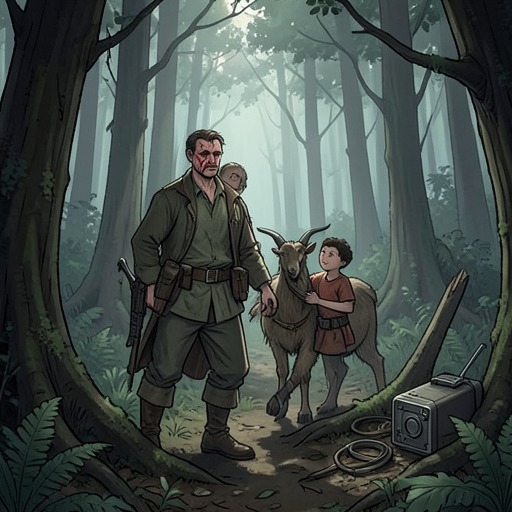
The Poor Woodcutter’s Wife calls for sanctuary and identifies herself to the unseen voice. The Man with the Goat and Shattered Face appears with his rifle. He has heard the gunshots and understands enough of her broken explanation to know that her husband tried to defend them and that their pursuers may follow. He does not require her to recount the event in full. Instead, he asks her to give him the child and follow him. The Poor Woodcutter’s Wife entrusts her daughter to him, and he receives the child with deliberate gentleness, as if carrying something sacred.
He leads them silently through the grove into a clearing the Poor Woodcutter’s Wife has never seen. The discovery changes the meaning of the place she had approached with fear: beyond the dense trees are a garden, fruit trees, flowers, and a cabin beside a rock. The Man with the Goat and Shattered Face does not enter the cabin; he takes the child to a grotto where a small goat with swollen udders is waiting. The refuge is thus not only concealment from pursuit. It contains the resource the child needs and a sheltered setting in which continued care can become possible.
The goat as nurse and companion
The Man with the Goat and Shattered Face sets the girl down facing the goat. They are nearly the same height, and he presents the animal to her as her wet nurse and third mother. The child hugs the goat; the goat settles into her arms, and they stand forehead to forehead, gazing at one another. The scene makes the relationship reciprocal in its own way: the girl receives milk and comfort, while the lonely goat gains a playmate.
The Man with the Goat and Shattered Face promises the Poor Woodcutter’s Wife that she will have all the milk her daughter needs and will no longer have to gather kindling. He recognizes that the arrangement also changes his own life: he loses the daily bundle of firewood but gains companionship for the goat. His explanation places loss and gain side by side rather than presenting care as costless. The mother’s earlier work remains part of the story, but the immediate burden of obtaining milk shifts to the man and his animal. The goat’s care is essential to the child’s survival, while the child’s presence answers the goat’s loneliness.
The protection continues beyond the first encounter. The Poor Woodcutter’s Wife and her daughter remain in the hidden refuge, and the girl grows, laughs, sings, babbles, and dances with the goat. The Man with the Goat and Shattered Face watches over them. Once a week he goes to nearby villages to barter goat cheese for basic necessities, bringing the isolated household into contact with the world without exposing the girl and her mother to the trains passing through the forest.
Protection within a wider separation
The sanctuary does not end the danger of war. The Man with the Goat and Shattered Face listens toward the east and fears the advancing Reds, just as he had feared the Death’s Heads and their collaborators. The Hunters of the Heartless have gone to ground or fled west, and the Poor Woodcutter’s Wife no longer witnesses the cargo trains passing through the forest, but the violence surrounding the refuge has not simply disappeared. His watchfulness, his trips for provisions, and the secrecy around the goat’s milk all form part of the protection he provides.
Nor does the child’s survival reunite the separated family. Her father, a former prisoner and displaced person, leaves a reunification camp and continues searching for the railway and forest where he believes he may find her. The story does not show him reaching the refuge. The forest man’s intervention therefore secures a life and creates a chosen family of mother, daughter, man, and goat, while leaving the father’s search unresolved.
The episode’s force rests on the progression from a cup of milk to a place of sanctuary. Care here is neither abstract nor effortless: it requires the Poor Woodcutter’s Wife to carry firewood, the Man with the Goat and Shattered Face to share food and shelter, and the goat to nurse and accompany the child. Against the machinery of forced transport and pursuit, these repeated acts create a small, guarded world in which the girl can live and grow.